
How ChatStack Calculates Software Development Costs
ChatStack calculates an estimated total development cost from your project requirements and technical specifications. This gives you a project-specific starting point for planning your development budget. The development cost is verified following a consultation, taking your selected scope into account. To get a figure for your own idea, describe it in the chat on this site, or ask in ChatGPT how much your app would cost to build with the ChatStack plugin. The same interview is available over MCP.
Our Methodology: The Story Point Engine
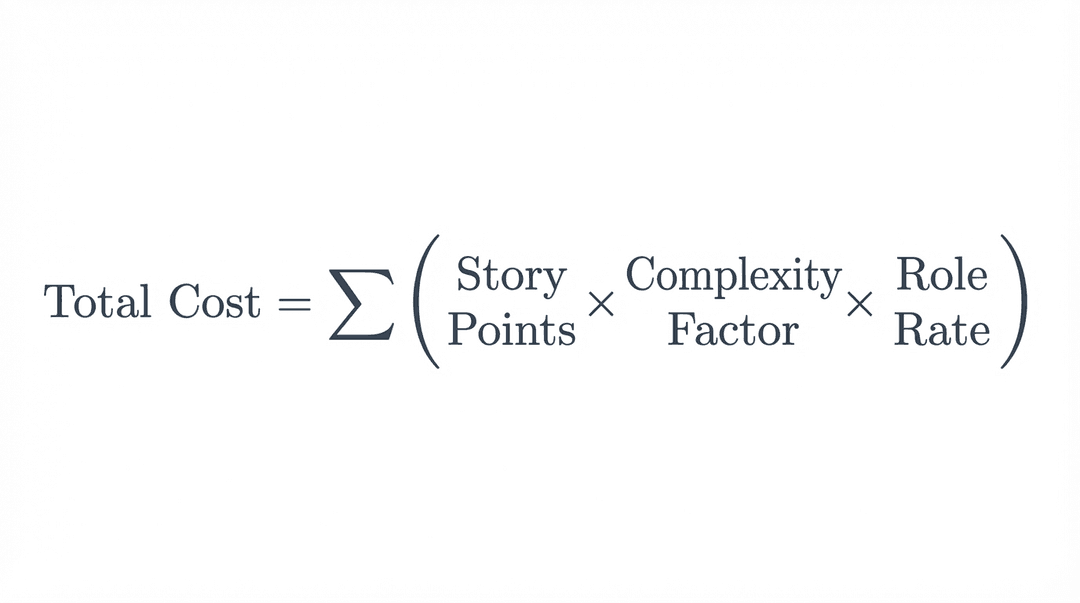
Our Cost Estimate Agent doesn’t just look at your idea; it looks at the architecture. Once our User Story Agent, Requirements Agent and Technical Specifications Agent define the requirements, the cost is calculated using a three-tier breakdown:
- Granular Decomposition: We break your project into “Story Points” based on complexity and size.
- Role-Based Allocation: Each story point is assigned estimated hours for specific roles (e.g., Frontend Developer, Backend Engineer, UI/UX Designer).
- Standardized Rate Card: We apply a transparent rate card to those hours to reach your total.
The ChatStack Formula:
Refine what goes into your MVP
In the ChatStack portal, you can remove user stories from your MVP scope to focus the first version on the functionality you need for launch. Changes to scope can affect the estimated development cost. A consultation is optional. When you take one, we review the selected scope and assumptions to verify the development cost.
The initial estimate is not a confirmed fixed-price quote. Changes to requirements, assumptions or the selected scope may change the development cost.
What the approximate 52% benchmark gap means
We sometimes cite an approximate 52% gap between ChatStack's indicative build estimates and the benchmark ranges we use for comparison. That figure is illustrative. It is not a guaranteed saving, and it does not mean generated code is right the first time.
A. Structured Data vs. “Vibe Coding”
The secret to low-cost, high-speed development is Context.
- The ChatStack Way: We generate a structured, JSON-based PRD. When this is injected via MCP (Model Context Protocol) into tools like Cursor, Claude Code, or Codex, the assistant has the agreed scope in one place. That reduces rework from missing context. It does not guarantee the code is right the first time.
- The Risk of “Vibe Coding”: Prompting an AI without a detailed PRD leads to “context drift.” This results in high token usage, constant rework, and “spaghetti code” that is nearly impossible to maintain.
- The Manual Alternative: Traditional manual development often needs larger teams to interpret vague requirements, which can add cost and time.
B. Expert-Led AI Implementation
We aren’t just an AI tool. App Developer Studio brings over 10 years of UI/UX, Agile delivery, and AI-accelerated implementation — including Cursor-led build with MCP connections across design, Jira, and backend — so we know where AI can be pushed and where human oversight is required. This “Human-in-the-Loop” approach ensures your project is scalable from day one. See Our Services.
What “52% below benchmarks” means
In marketing we sometimes cite an approximate 52% gap between ChatStack's indicative build estimates and the benchmark ranges we use for comparison. Those benchmarks are built from typical market pricing assumptions for comparable software scope (for example, blended day rates and effort ranges for similar-sized projects), not from a single vendor quote or a guarantee of what you will pay.
The percentage is a representative illustration across common project shapes; your outcome can be higher or lower depending on geography, team seniority, risk buffers, what is in or out of scope, and how vendors price. Treat ChatStack's estimate as planning guidance, then validate with real proposals.
Comparison at a Glance
| Feature | Traditional Agency | “Vibe Coding” (No PRD) | ChatStack + AI |
|---|---|---|---|
| Cost | 100% (Benchmark) | Low initial / High rework | Illustrative ~52% gap vs our benchmark ranges |
| Requirements | Manual / Vague | None / Prompts | Structured JSON PRD |
| Accuracy | Subject to interpretation | High “Hallucination” risk | AI-Optimized Context |
| Maintenance | High Cost | Technical Debt / Spaghetti | Clean, Modular Code |
Ready to see your number?
You can generate a comprehensive, AI-readable PRD and get your estimated total development cost on our Home Page.